




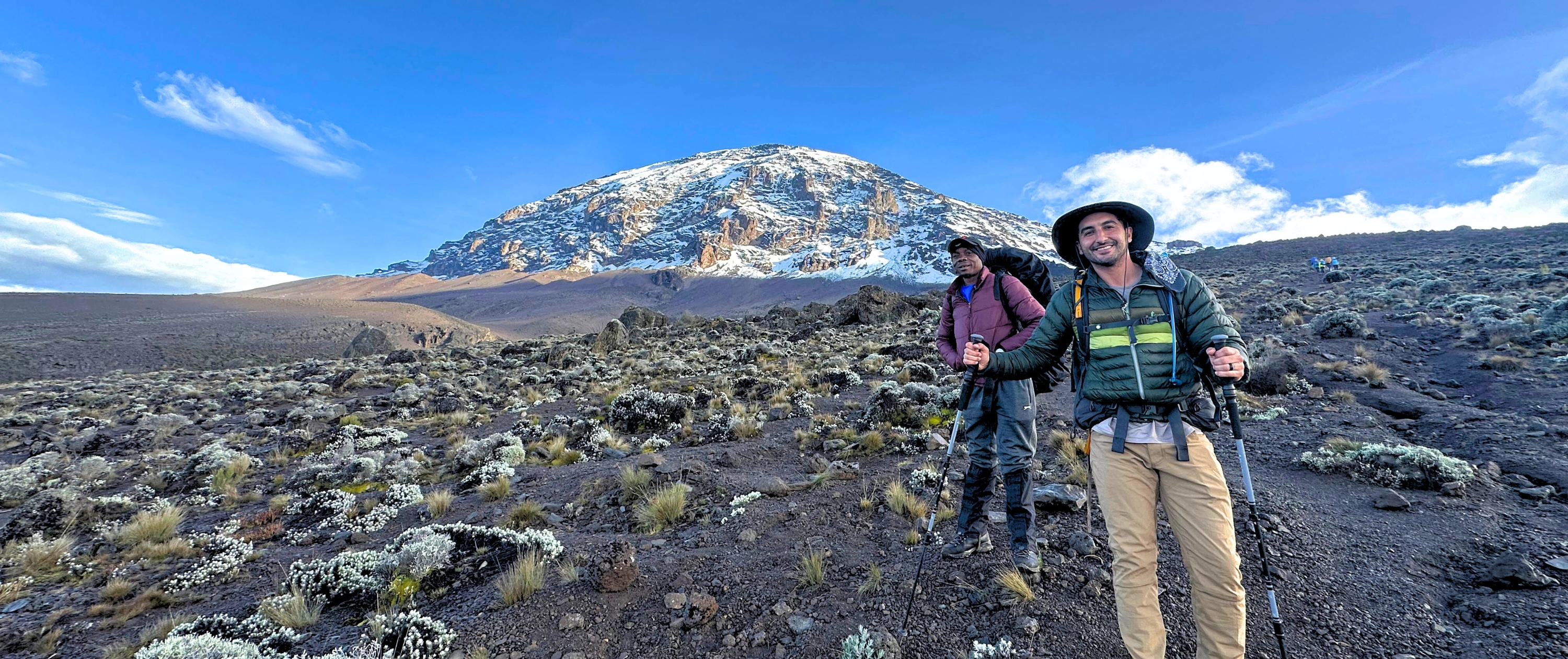


On a Kilimanjaro climb, you start walking in a hot and humid rainforest and quickly ascend into a world of ice and glaciers. This means you need to pack hiking gear for multiple climates!
We know that putting together a Kilimanjaro packing list can seem a daunting task. So we've made it as easy as possible for you by putting together an extensive packing guide that you can follow. If you pack everything on our list, you can rest assured you'll be more than sorted for your Kilimanjaro climb. Schedule a call with us, and we'll help you with any questions you might have.
But if you don't feel like reading a blog post, you can instead watch our video below:
Kilimanjaro packing checklist
We start with a packing checklist that you could print out to use when actually packing for your trip. Then we discuss each item, giving details and advice where relevant.
Equipment
You need to bring the following carrying equipment to Kilimanjaro:
- Trekking poles
- Sleeping bag
- Sleeping mat
- Backpack (between 35 and 50 litres)
- Backpack rain cover
- Dry bags
- Duffel bag (between 65 and 100 litres)
- Hydration pack (water bladder)
- Water bottle(s)
Here's a little more detail on each of the above important items ...
Trekking poles
We highly advise everyone going on a Kilimanjaro climb to pack some lightweight, quality trekking poles. These will help with your stability and confidence on tricky terrain, and also help to alleviate some of the impact on your knees during the long downhill that you face on the final two days of the trek.
The trekking pole market is awash with great options, so you're spoilt for choice. Some of the main features to consider are the poles' length, durability and collapsibility. Ensure the trekking poles are appropriate for your height (especially if you're particularly tall or short), are strong even in extreme cold weather (carbon poles are brittle), and can telescope or fold enough to allow you to stow them in your checked luggage when flying.
Also ensure the trekking poles come with adjustable wristbands.
Our final tip in terms of trekking poles would be to practise with them before coming to Kilimanjaro so that you've already grown familiar with how to extend and collapse them and aren't figuring things out on day one of your trek.
Learn more: How to choose and use trekking poles.
Sleeping bag
At Follow Alice, we provide our clients with winter sleeping bags to use during the trek at no extra cost. These are down-filled and able to keep you cosy in below-freezing conditions. And that's exactly what you experience high up on the mountain! So if you're going to bring your own sleeping bag, please ensure it's a four-season bag capable of keeping you warm even at -20℃ (-4°F).
Note that the mummy-shaped sleeping bag is a good option for Kilimanjaro as the footwell is narrower, which means there's less air to heat up and also less fabric is needed, making the bag lighter to transport. We also recommend down-filled sleeping bags as down is lightweight and very insulating.
Learn more: The best sleeping bags for Kilimanjaro.
Sleeping mat
A sleeping mat is an essential part of your Kilimanjaro packing list if you're going to be camping (and only those trekking the Marangu route stay in huts instead of tents). Not only does a sleeping mat offer some padding, it also helps to insulate you against the cold emanating from the ground. Insulated sleeping mats are especially good at this.
At Follow Alice, we provide clients with sleeping mats to use on the trek at no extra charge. But please note that your sleeping mat must go into your duffel bag, which is given to a porter to carry. So if you intend to buy or borrow one from home, ensure it's not too bulky, nor is it too heavy, as there's a weight limit to each duffel bag to ensure you don't overload a porter.
Sleeping bag liner
A sleeping bag liner (or inner) has two purposes: hygiene and warmth. Whether you're using your own sleeping bag or a rented or borrowed one, you can't wash the sleeping bag often or easily, so a liner is nice for hygiene and also for helping to keep the bag cleaner for longer. A thermal sleeping bag liner also offers a nice bit of extra insulation at night.
Backpack

Your backpack becomes like an extra appendage on a Kilimanjaro climb, so it needs to be comfortable and work for you. You'll us it to carry all the items that you might need during the day, including your snacks, drinking water, camera and backup layers of clothing.
It's important you make an educated decision as to what backpack to bring. Really good, quality backpacks have an internal frame. They also have padded shoulder and hip straps, as well as sternum straps.
You should also look for a pack with a suspended mesh back, as this allows your body heat to escape. This is something that's especially important on those warmer days lower down the mountain.
Ideally, you want a backpack with a large (2 to 3ℓ) built-in hydration pack that allows you to drink from a hose.
Some backpacks also come with their own fitted rain cover, which is useful.
Further, if you intend to bring along trekking poles, see if there are hooks for attaching these to the exterior when you want your hands to be free.
Learn more: How to choose to a backpack for high-altitude trekking.
Do training hikes with your backpack
As we discussed in How should I train for Kilimanjaro?, you should do some training hikes using your backpack. In this way, you can ensure the backpack is comfortable.
On these training hikes, we recommend that you also carry all the water and other items that will go into it on Kilimanjaro to get used to the weight.
Backpack rain cover
We highly recommend you pack a rain cover that's fitted to your backpack, even if your backpack is water-resistant. Nobody needs the added challenge of carrying a sopping, heavy backpack when tackling a monster mountain like Kilimanjaro.
Many outdoor backpacks come with a built-in rain cover. This is really useful, as you stand no chance of forgetting it! It's also perfectly sized for your backpack.

A misty photo en route to Barranco Camp by our client Simon
Dry bags
In an attempt to reduce pollution, the Government of Tanzania has prohibited any plastic carrier bags from entering the country. You're therefore advised to avoid having plastic carrier bags in any of your luggage.
While your backpack rain cover should keep the contents of your bag dry, it's a good idea to also bring along some dry bags. These are useful for:
- Protecting your clothes in case there's a leak in your bag
- Storing worn, sweaty clothes
{{leadmagnet-one}}
Duffel bag
Your duffel bag – or any other soft bag – contains everything else you need for the trek, including your sleeping bag and sleeping mat. Your duffel bag is carried by one of the porters in your mountain crew and should weigh under 14 kg (31 lb).
Please don't bring a stiff bag like a suitcase, or anything too precious, as it could get a bit squished when carried by the porter. It's also not as comfortable or easy for the porters to carry.
Ensure at the start of every day that you've put what you might need for that day's climate in your backpack. You'll also carry your own water and food. Everything else must fit into your duffel bag.
That said, if your sleeping bag simply can't fit into your duffel bag, then our team will strap it onto the top of the duffel bag. They'll also put a waterproof covering over it all, so you don't need to worry about your bags getting wet in the case of rain. But please still stick to the 14 kg (31 lb) overall weight limit.

Your backpack is needed just for storing your stuff for that day's hike
Hydration pack
Every Kilimanjaro trekker should carry two to three litres of water per day. While the mountain crew carries the water needed for the entire trek, you have to carry what you need for each day in your own water vessels.
We cannot over-stress how important it is to have enough water to drink while on your climb. Not only are you being very active and so need to hydrate, but water also helps to ease the symptoms of Kilimanjaro altitude sickness.
Most hiking bags have hydration bags (also called water bladders). A well-known brand of hydration packs is the CamelBak.
Hydration packs come with a drinking hose built into them, which is really great. This means that instead of reaching for a water bottle when thirsty, you can just pick up the mouthpiece and drink from there. You should take sips of water often – if you're thirsty, then you're already dehydrated!
On cold days like summit day you want to insulate your hydration pack so that your water doesn't freeze.

Built-in water bladders with drinking hoses are the best
Water bottles
We recommend bringing at least one water bottle with you, though two is better. Ensure your water bottles are high-quality and have secure lids or valves. A leak won't be welcome.
Choose bottles that you open and shut with your mouth, as it'll be annoying to have to free up both hands every time you want to have a drink. And if you were to drop the lid in the dirt ... argh, how annoying.
You should always leave camp each morning with a full water bottle, even if your hydration pack is full.
Note that when things get very cold, it's necessary to keep your water bottle as close to your body as possible to avoid the water in it freezing. Putting your water bottle inside a thermal sock also helps to keep the water liquid. Further to this, note that water freezes from top to bottom, so if you carry your water bottle upside down, then you can still drink from it even if the top part has started to freeze.
Finally, on summit day, the water in the hose of your hydration pack will freeze over, so this is when your water bottles really come into their own.

The top of Kilimanjaro is a dry, harsh place as shown in this pic by our client Andrés
Footwear
You should pack the following footwear for Kilimanjaro:
- Hiking boots
- Gym shoes or sneakers
Hiking boots
The most important item on your Kilimanjaro packing list is a pair of comfortable, worn-in hiking boots. As such, these shouldn't be an afterthought in your Kilimanjaro preparation. There are so many options out there to choose from when shopping for the perfect pair of boots.
We recommend opting for either leather or a synthetic fabric like that used in Gore-Tex boots. Leather boots that are properly looked after last longer than any other type of boot. Synthetic fabrics, on the other hand, are easier to break in.
We also want to stress the importance of either wearing your boots or having them in your hand luggage on your travels to Tanzania. Should your luggage disappear, you want to at least have your essential items on you. We always do our best to help clients with any needed items, but new or borrowed hiking boots can compromise your climb.
Learn more: The best hiking boots for Kilimanjaro.
Gym shoes or sneakers
After a long day of hiking, the thought of sitting back and kicking your boots off is pure bliss. This is great except for the fact that the temperature can plummet to well below freezing higher up on the mountain. So when you're packing for Kilimanjaro, it's a good idea to throw in a pair of comfortable, closed sneakers to wear around camp.

Andrés took this pic of his climbing group in their camp shoes
Clothing
We recommend you pack the following inner layers:
- Thermal long-sleeved vests
- Long johns
- Fleece (or similar)
- Sports underwear
- Socks
- Winter jacket
- Waterproof jacket
- Waterproof overpants
- Hiking trousers
- Gaiters
Climbing Kilimanjaro means hiking through five distinct climate zones. For this reason, it's helpful to have quite a few layers to work with.
Thermal long-sleeved vests
You should pack around three long-sleeved thermal vests with good sweat-wicking properties for your Kilimanjaro climb. This includes one vest that you save for summit day. Why? Your summit day hike is by far the longest hike of the entire Kilimanjaro trek; you're on your feet for around 12 to 15 hours! So, having a fresh, dry layer set aside especially for this day's hike is ideal.
Your long-sleeved vests are your base layer, which means they'll sit against your skin. You therefore want to choose breathable fabrics, as they allow moisture to escape easily, and this will help to regulate your body temperature. Put another way, you want to avoid fabrics that take a long time to dry (like cotton), as this will lead to you becoming chilled whenever you stop exercising.
Merino wool and bamboo are both good choices of natural fabrics for your thermal vests. Alternatively, you could opt for vests made from synthetic materials like nylon, polyester, polypropylene, MicroModal or a blend of fabrics.
Long johns
For your long johns (or leggings), you want to choose comfortable fabrics that have sweat-wicking properties, just the same as with your thermal vests (discussed above). These will sit against your skin all day long and need to stay as dry as possible to help regulate your body temperature.
Fleece (or similar)
Your middle layer is for your torso and is worn over your base layer. This garment should be comfortable and easy to move in. We recommend a thin fleece or parka for this layer.
Sports underwear
So it goes without saying that a fresh set of underwear is always a pretty good way to start each day! That's why we recommend that you bring multiple pairs along with you.
It's best to wear sports pants (and bras) on Kilimanjaro, as they're comfortable and breathable. Again, avoid cotton. You want fabrics that wick away sweat.
And please be sure to not wear any new underwear, as you want to know for sure that what you put on in the morning will still be comfortable after hours of movement!
Socks
Just like underwear, we suggest that you bring a few pairs of socks along with you. And we advise that you bring three different types of socks along with you:
- Hiking socks
- Thermal socks
- Sock liners
First and foremost, you must pack some regular hiking socks. We advise that you test out your hiking socks before coming to Kilimanjaro. Use them when breaking in your hiking boots. This way you'll be able to detect any troublesome seams or the like.
We're sure you've noticed a trend by now: have a fresh 'everything' that you save for summit day. This certainly goes for your hiking socks. Only note that your summit day socks should be thermal socks, as you need the extra warmth to avoid cold feet.
We also suggest you wear sock liners. Not everyone does, but these are great in helping to prevent blisters because the friction gathers between the liner and the sock rather than between your skin and the sock. It's quite common for climbers to get blisters on their feet, especially on summit day when you're on your feet for around 12 hours.
If you want to know more about avoiding and dealing with blisters, please read How to prevent (and treat) foot blisters when trekking.
Learn more: The 3 kinds of socks you need for Kilimanjaro.
Winter jacket
A good-quality winter jacket is a very important item on your Kilimanjaro packing list.
The first couple of days of the climb are relatively warm and humid, so your winter jacket won't be needed and can be kept in your duffel bag. From then on, you'll keep it in your backpack so that you can haul it out whenever you want it.
You're likely to start wearing your winter jacket when you reach the moorland zone. You'll certainly be wrapping up in it from the alpine desert zone! And it's also your best friend at camp in the evenings.
Down is the best filler for a winter jacket, as it's lightweight, compressible and very insulating. It's what we've used in our Follow Alice winter jackets. That said, other good inner materials that
You can either buy a winter jacket of your own or rent one from Follow Alice for US$65.
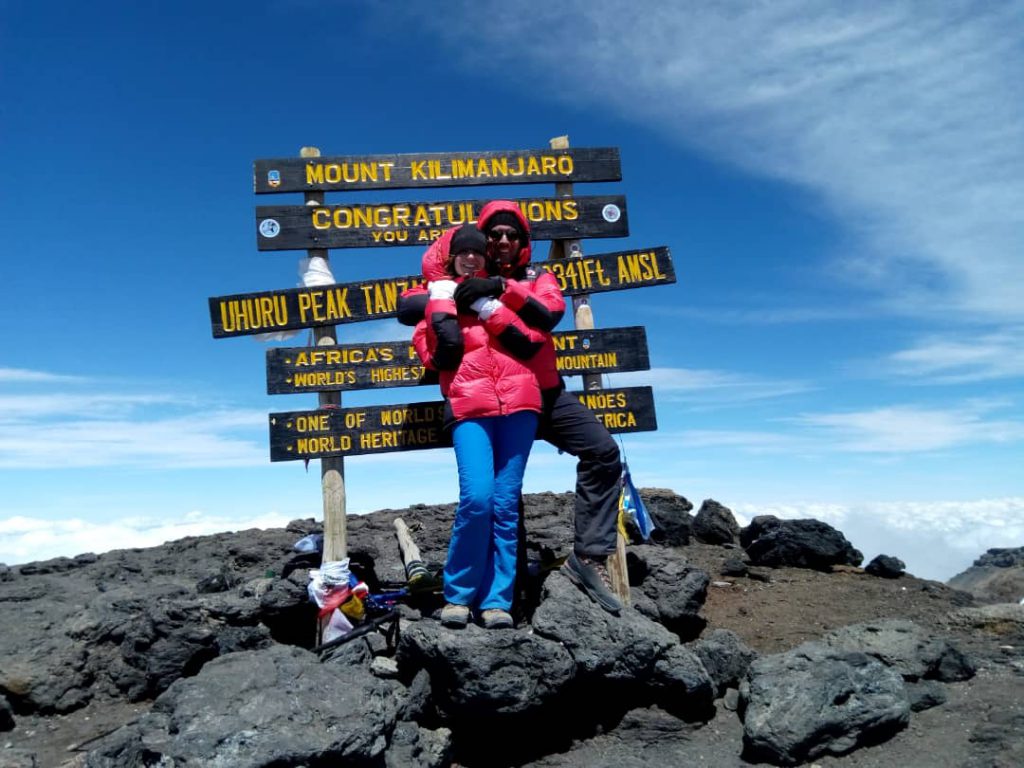
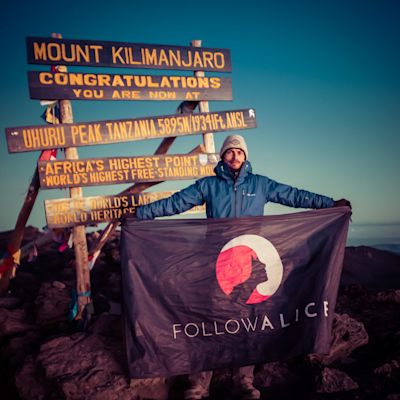
Two of our Follow Alice down jackets are doing their job at the summit of Kili!
Hiking trousers
Pack at least one pair of durable, breathable and comfortable trousers. We love convertible (zip-off) trousers that you can turn into shorts on warm days. Again with the two-in-one winning formula! Obviously, you could choose instead to pack regular hiking trousers as well as a pair of shorts.
Some people like to wear trousers no matter the temperature as they protect your legs from sunburn, insect bites and scratches. Long trousers also help to prevent dirt and pebbles from finding their way into your boots.
Waterproof jacket
Waterproof garments are essential for the first few days of your hike, especially if you climb Kilimanjaro during the rainy season. That said, it's smart to carry waterproof gear no matter when in the year you climb.
While regular rain gear is waterproof, it generally isn't very breathable. Given how much you sweat when hiking, it's important to have a rain jacket that's relatively lightweight and has inner membranes to make it breathable.
We recommend bringing a jacket that has a 2,000 hydrostatic head (this tells you how waterproof the jacket is).
A windbreaker also goes a long way on Kilimanjaro. There's nothing worse than wearing multiple layers to keep warm and the wind still cuts right through. To keep the load light, we suggest looking for a waterproof jacket that's also a windbreaker. We love a two-in-one solution!
Also, jackets with elasticated wristbands are helpful in keeping out the cold and wind.

Waterproof overpants
You also want to ensure you have a pair of lightweight, breathable and comfortable overpants that you can easily pull on to keep your legs dry. Look for ones with stretch or zips near the bottom to allow you to pull them on without having to take off your boots. Also, ensure they sit comfortably over whichever trekking pants (trousers) you choose to wear.
Gaiters
Gaiters aren't essential, but we do recommend using them.
Gaiters are helpful in:
- Keeping your calves and feet dry
- Preventing sticks and stones from getting into your shoes (super annoying!)
- Protecting you from ticks, snakebites and other such nasties
- Keeping you dry should you walk through snow on summit day

Things can get muddy on Kilimanjaro, making gaiters useful
Accessories
Some important accessories to pack for a Kilimanjaro climb are:
- Sunhat
- Warm hat
- Balaclava or snood
- Head torch (flashlight) and spare batteries
- Gloves or mittens
- Glove inners
- Sunglasses
Sunhat
A sunhat is important for the beginning and end of the trek when you're lower down on the mountain. The heat of the sun can be very intense in Tanzania – remember that you're near the Equator! A sunhat is better than a cap to protect the back of your neck.
The odd person might like to bring a headband so that sweat doesn't run into your eyes.
Warm hat
As you climb higher, you need a warm hat like a beanie. A beanie can also be worn when you sleep to avoid heat escaping through your head.
Balaclava or snood
We suggest you bring a thermal balaclava for summit day as this helps to keep your head, ears and neck warm.
Alternatively, consider a scarf or, even better, a thick snood, as this stands no chance of slipping off or flapping annoyingly.
Head torch (flashlight) and spare batteries
A head torch is your best friend while on a Kilimanjaro climb to help you get around camp when it's dark. Further, on summit day you leave camp at midnight and hike for hours in the dark.
Don't want to climb in the dark? Maybe you should consider a Kilimanjaro full moon climb where the light of the moon guides you to the summit?!
You also use your head torch in the evenings, so add a few extra batteries to your Kilimanjaro packing list – you will use them!
Gloves or mittens
You absolutely must pack winter gloves (or ski gloves) to keep your hands warm! We especially like mittens for summit day, as having all your fingers together generates more warmth.
Having said that, mittens do make it quite challenging to take pictures. So if you'd prefer fingered gloves, do ensure they're a quality pair that offer proper insulation.
Glove inners
For summit day, one pair of gloves simply isn't enough. Some glove liners, or glove inners, will help to ensure your hands and fingers don't become icicles.
Sunglasses
Polarised sunglasses or ski glasses are essential, and not just for looking ultra cool in pictures!
On summit day you reach the arctic zone of Kilimanjaro, which means lots of snow and glaciers. The sun reflects off the snow, which can cause snow blindness. Snow blindness is a temporary but painful blindness that occurs when the human eye is overexposed to the Sun's UV rays. No fun at all!
You might also like to pack a sunglasses cord if you have one of those noses that likes to ditch glasses at the slightest opportunity. Or you could even bring ski glasses.
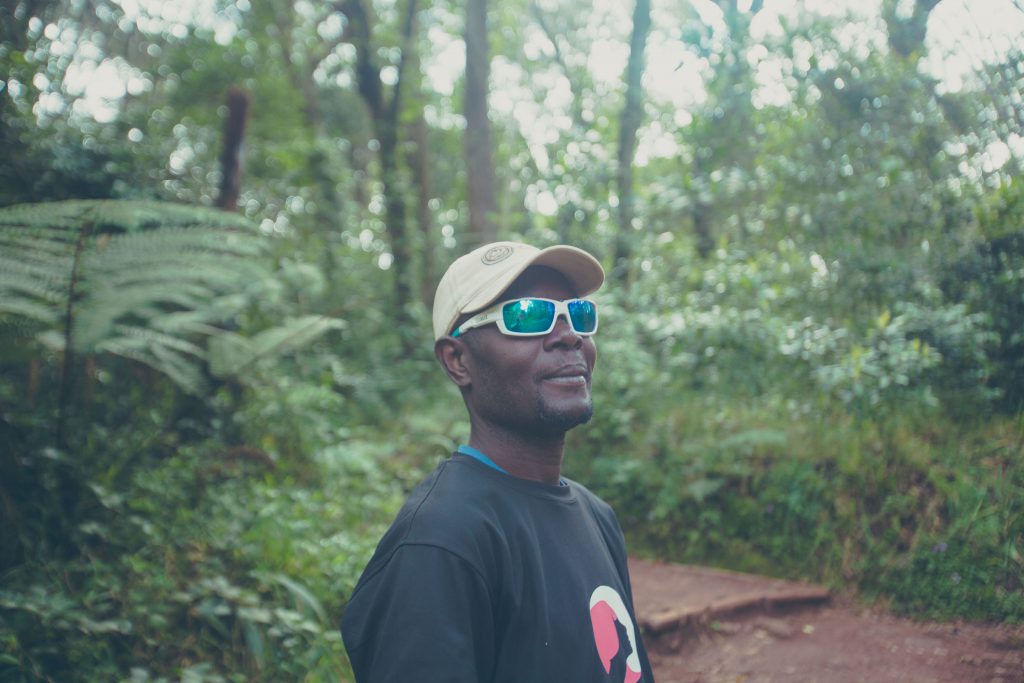
On clear days the glare can be intense, so pack your sunnies!
Toiletries and first aid
We recommend you pack the following personal items:
* While there aren't any showering facilities on the mountain, you will get what the locals call 'washy washy' every day. This is a bucket of water for you to use to wash your hands and face. This is when you'll need the microfibre towel so that you can dry off.
Since personal items tend to vary from one person to the next, please add whatever else you feel is necessary to your toiletry bag checklist.
Finally, please note that it's very common to experience symptoms of altitude sickness when climbing Kilimanjaro. Symptoms include diarrhoea, nausea, dizziness, headaches and sleeplessness. This is when meds like Diamox and painkillers come in handy.
Think carefully about what to include in a small, personal first aid kit. And even better, speak to your GP beforehand for advice on the matter.👩🏽⚕️
Learn more: Kilimanjaro altitude sickness.
Toiletries for women
For women, we recommend packing a urinating device and a pee cloth.
A urinating device like a Shewee lets you pee while standing. A pee cloth, like a Kula Cloth, is a hygienic, environmentally friendly way to avoid the drip-dry method after peeing!
We also recommend bringing your menstrual cycle products, no matter the time of month, as high altitude can bring on your period unexpectedly.
Finally, if you find you tend to have to urinate during the night, you might consider bringing a pee bottle. It's never fun to have to exit your cosy tent just to take a leak!
Learn more: Advice for women climbing Kilimanjaro

Porters are the true backbone of any Kilimanjaro climb
Tech items
Some of the tech gear to consider packing is as follows:
- Camera
- Cellphone
- (Solar) power bank
- Small binoculars
There's limited cellphone reception on Kilimanjaro, but you can get reception at some of the campsites, namely Barranco, Karanga, Barafu, Mweka, Tarn Hut and Horombo. Have a look at the description of the different Kilimanjaro routes to see which ones stop off at these campsites.

Bring along your camera to capture special moments and sightings
Documentation
To travel to Tanzania, you also need the following:
- Passport
- Visa
Please don't forget your passport! We can help with replacing pretty much anything if needed, but sadly, we can't replace your passport. Make it number one on your Kilimanjaro packing list. And please ensure your passport is valid for six months after your arrival date in Tanzania.
You also need a Tanzanian visa. US, Canadian, British and most European citizens can simply obtain their visas upon arrival at the airport. The cost is $100 for US passport holders and $50 for others. If you're a citizen of a different country, please check with your embassy whether or not you can obtain a visa upon arrival. You can also view the Tanzania Visa Policy.
Miscellaneous or optional items
We have a handful of suggestions for other bits and bobs you may want to add to your Kilimanjaro packing list. These aren't essential, but can make your climb even more enjoyable.
* The mountain crew use water-purifying tablets to purify the water they provide you for drinking. These make the water safe to drink, but can alter the taste. Some folks like to add flavour sachets to their drinking water to make it more palatable. And adding some electrolytes to your drinking water is also a very good idea.
What's provided by Follow Alice
Ultimately, we want to keep you warm, safe and healthy during your climb! We feel so strongly about this that we included the following equipment in all of our Kilimanjaro packages at no extra cost:

We also provide clients with the following items, but please note the rental fees attached to each:
We recommend you use our equipment for the above items as they adhere to our Kilimanjaro safety guidelines. But do, of course, feel free to bring your own if you prefer.
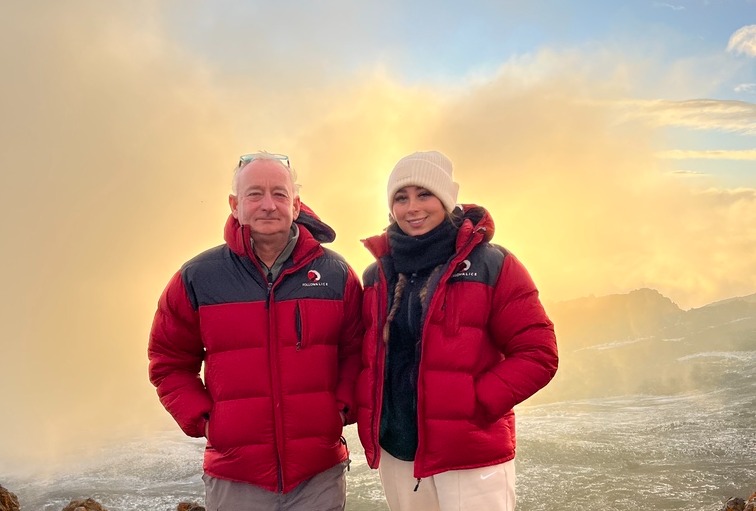
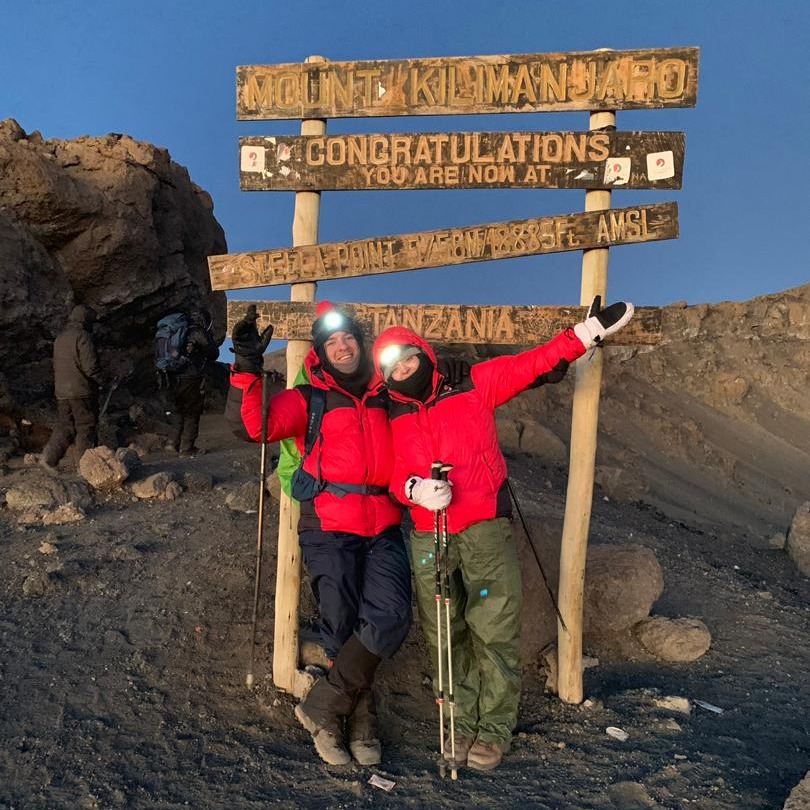
Two of our lovely clients in their Follow Alice jackets